


Claude Leaf: On Genuine Interaction with AI
What determines the quality of a Claude session? On seeds, soil, the right questions, and ripening; and the tool that builds the infrastructure for it all: Claude Leaf.
Let us think about a conversation between two people. In one, there are words but no accumulation; chatter. It spreads fast like air, flares up, and disappears. In the other, something grows: understanding, decision, transformation. The difference lies not in the number of words spoken, not in the tokens generated, not in a bloated context window; but in the quality of the questions asked and where those words ultimately go.
A Claude session moves between these two poles as well. Some end leaving something concrete behind: a decision, a structure, a text, an understanding. Others end leaving only the noise of past messages; a few good ideas lost inside, perhaps...
Every conversation begins with a seed: a question, an intention, a curiosity. The difference lies in how far that seed can grow. And no seed ever ripens in a hurry. Does it?
Thought is not linear
A quality brainstorming session, a good design process, or a deep research session never follows a straight line. A sprout does not only grow upward; it reaches in every direction, tries, pulls back, tries again. This process takes time, patience, and sometimes the courage to stray down wrong branches.
You begin with a hypothesis; the data refutes it. You try a different frame; that breaks too. Eventually you arrive at an entirely different question, and that question is the real one. Most often, the most valuable finding is the answer to the question that was never asked at the beginning.
This messiness is not a mistake; not inefficiency, not a bad prompt. It is the nature of thought.
When designing a system, you weigh the same architectural decision from three different angles. When writing an article, you try the same section in two different tones and abandon one, but three hours later you cannot remember why. In a research session, your initial hypothesis quietly shifts in the middle of the conversation.
Claude knows this. You forget.
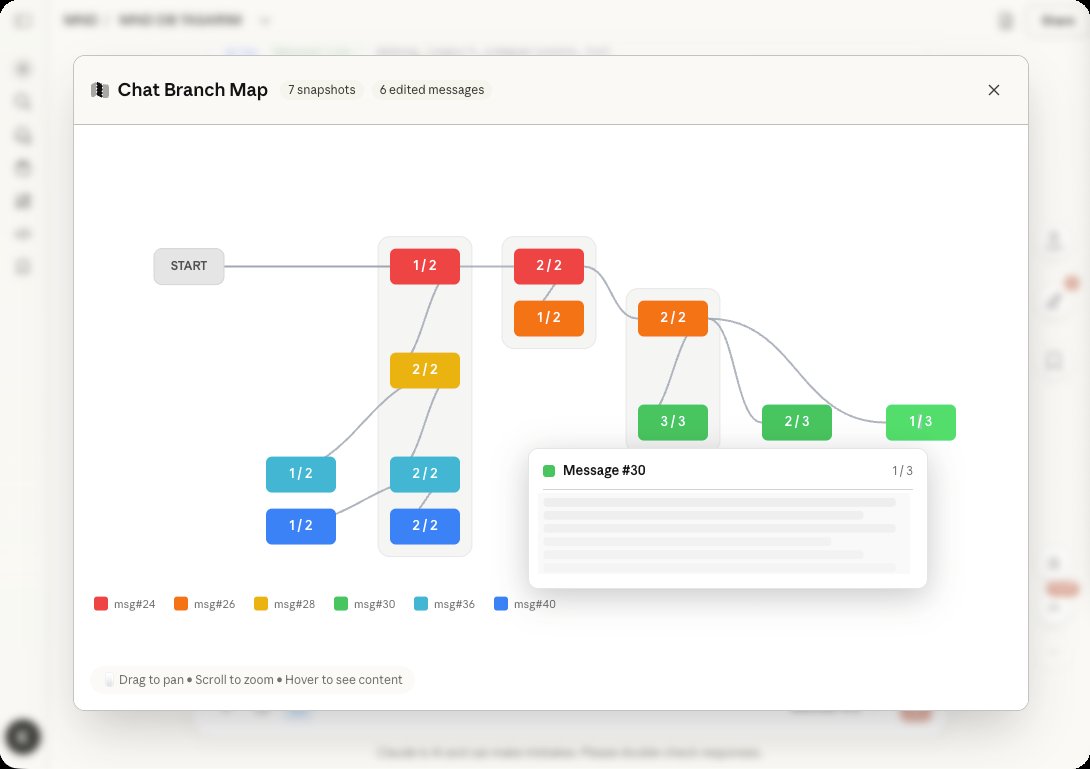 The map of thought: every branch a decision, every color a turning point.
Context loss happens silently
A tree grows stronger as it branches, but every branch must continue to be nourished. A branch that loses its connection withers, dries, and falls. Ripening happens only where that connection does not break, patiently and through continuous nourishment.
The same thing happens in a long, deep session. A critical response disappears pages below. The reason a decision changed is erased. Which question triggered that breakthrough leaves no trace. The conversation has grown, but there is no map of its growth. You have walked through the forest; you cannot find the way back.
This loss is not loud. It gives no error message, sends no warning, leaves no trace. It goes unnoticed. When the session ends, everything seems to be in its place; until the next day when you realize you are asking the same question again.
This is largely what distinguishes a quality conversation from an ordinary one: how much of the context is preserved. The depth of a session is determined not only by what was discussed within it, but by how much of that depth remains accessible.
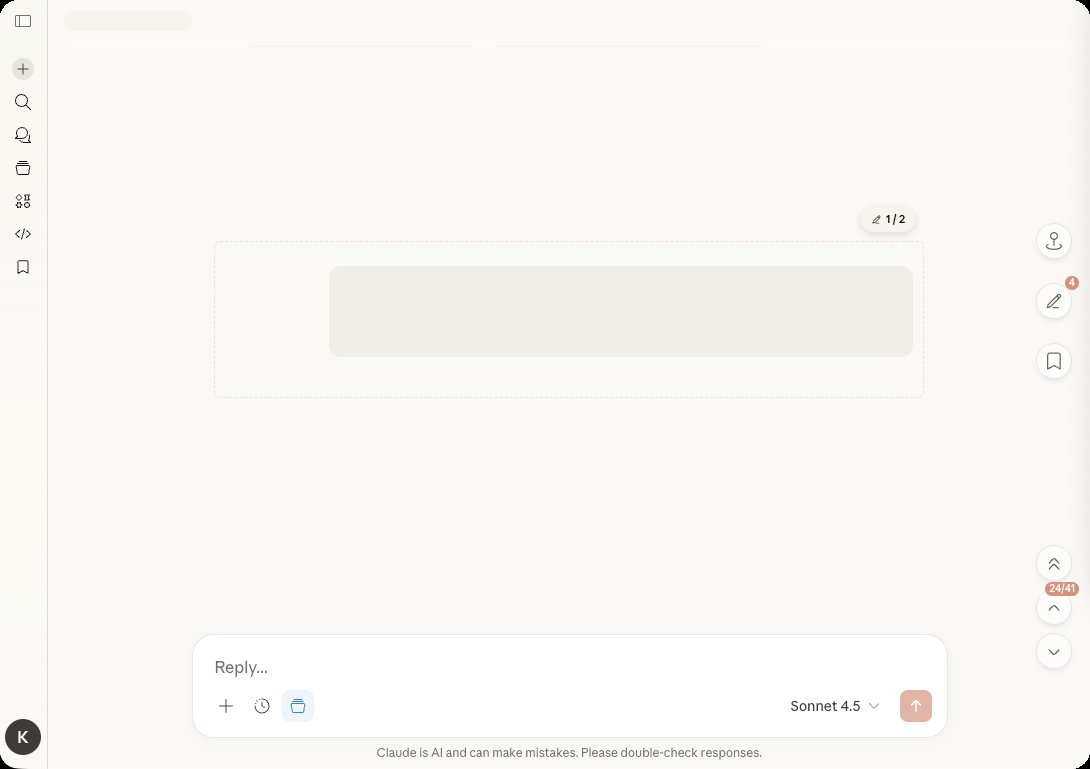 Which message changed is now visible; the connection does not break.
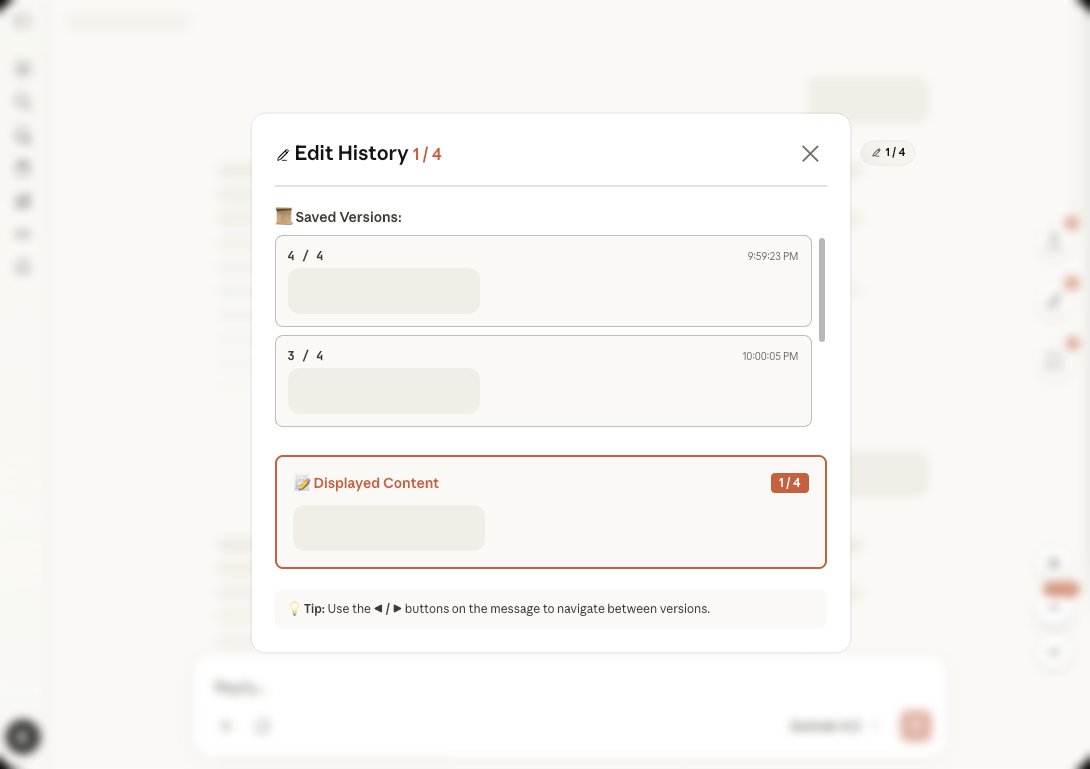 The reason a decision changed can no longer be erased.
Structure must be beneath thought, not in front of it
Healthy growth requires invisible infrastructure; a root system. No one sees the roots, but the tree stands because of them. A good working environment is the same: it does not obstruct thought, it carries it. And it quietly ensures that everything accumulated over time does not get lost.
You know where you are. You can mark a critical finding, a turning point, every step of a systematic progression. You categorize your accumulated knowledge and return with a single click. Most importantly: you can read decision changes, alternative paths, which direction the conversation turned at which point.
This is not merely a record; not a log, not a backup. It is the map of thought: a record of where the branches reached, which ones bore fruit over time, which ones dried and fell.
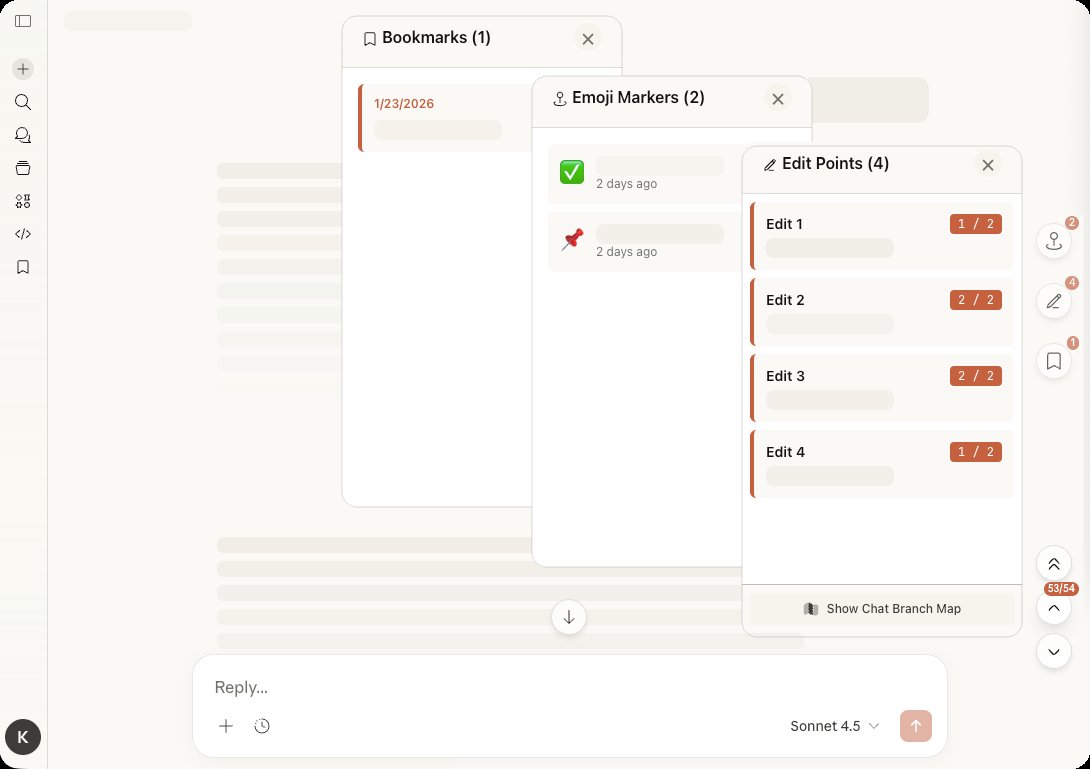 Infrastructure in the background, silently.
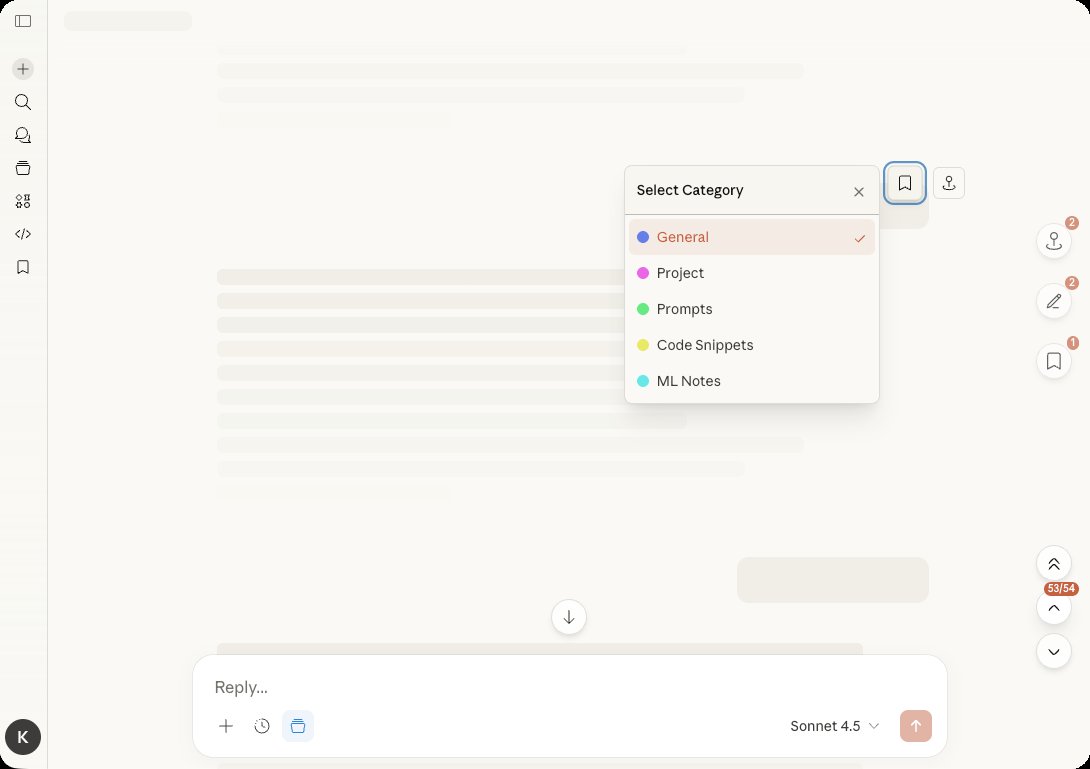 Accumulated knowledge sorted into categories; everything waits in its place.
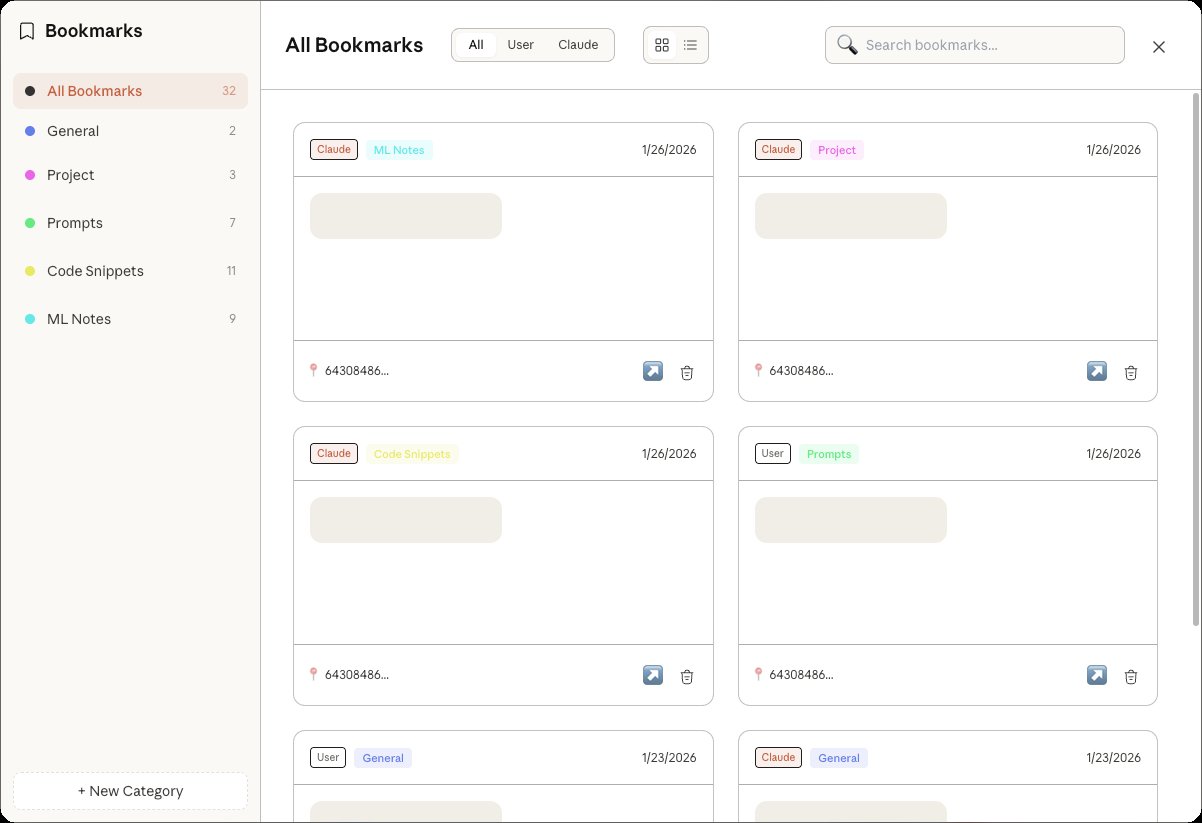 32 bookmarks, 5 categories; at a glance.
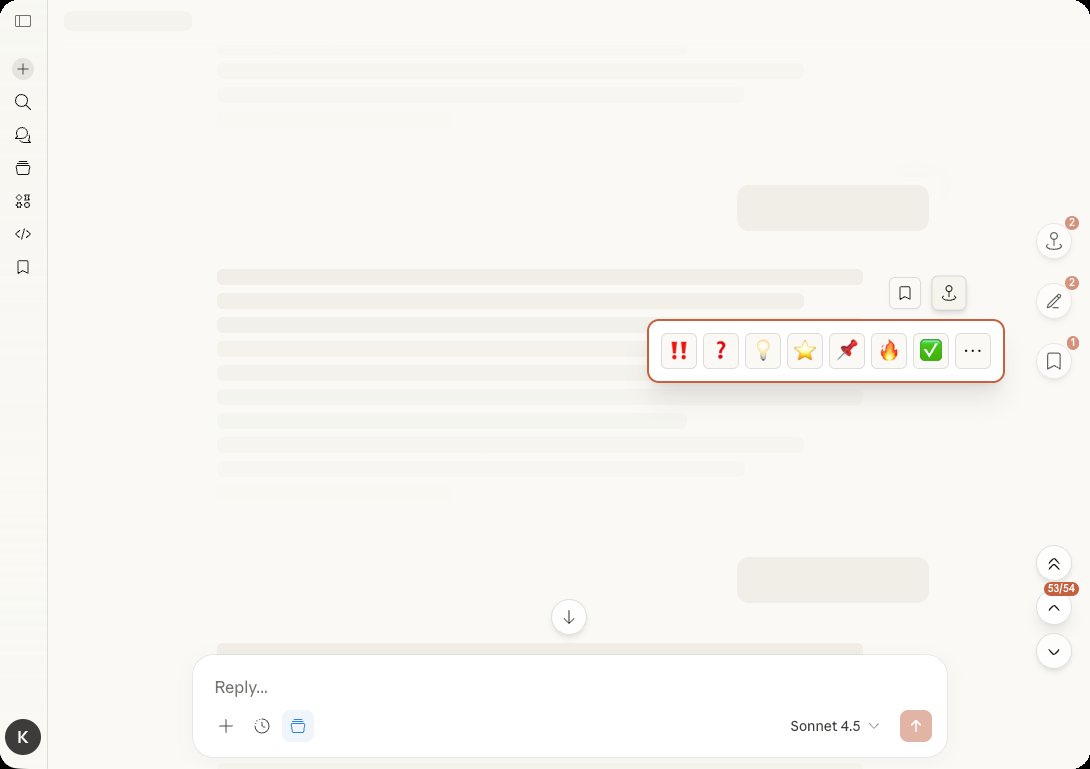 Critical moment, turning point, completed step; each carries a different mark.
 In a long conversation, your eye knows where to go.
The tool must stay in the shadow of the idea
The leaf is the lung of the tree. It breathes silently, performs photosynthesis, adds color, transforms with the seasons. No one tells it to work; it is simply there, and the tree lives with it.
Claude Leaf aims to be the same. Inside the conversation, invisible but functional. It quietly takes over navigation, marking, reading history, accumulating knowledge; you simply think.
A good tool makes itself forgotten. You do not feel yourself using it; it has become a part of you, and without it you feel incomplete. A pen enables writing, a tool enables building, an environment enables growth.
The infrastructure that turns a conversation into a real working environment must be the same. In the background, silently. It must not pull you away from your thought; on the contrary, it must prepare the ground for your thought to go deeper, wider, and more freely over time.
The seed grows, gives branches, and the fruit ripens when its time comes.
 The environment does not watch you; you do not notice the environment.
Right hands, right soil, right questions...
Every tool gains meaning in the hand that holds it. Every seed can only take root and bear fruit in its own climate; the right soil, water, and light. Every person fully expresses themselves only when they find their true interlocutor.
These three seem different but are subject to the same law: potential alone is not enough. And ripening never happens instantly; neither in nature, nor in thought.
No matter how powerful Claude is, it is limited by the depth of the questions directed at it. And sometimes that limit is only ourselves. A shallow question gives a shallow branch; a sharp question deepens the root. Sometimes a single word can be a more magical touch than an entire paragraph.
The one who feeds the seed is you. The one who holds the light is also you. How deep a conversation goes begins with how genuinely you enter it and how right the questions you ask are.
Formalism, rote thinking, carelessness, and leaving everything to AI; these are the conditions in which the seed rots. No matter how good the tool, in the hands of someone using it with shallow intent it produces something shallow. Depth does not come without being demanded; not with good intentions, not with long prompts, not with beautiful tools. Ultimately AI is also a tool: a remarkable machine for those who can use it, but still a machine. Nothing more, nothing less.
Claude Leaf is open source. You can view the source code and contribute on GitHub.
To install the extension, visit the Chrome Web Store.
Comments (0)
No comments yet. Be the first to share your thoughts!