

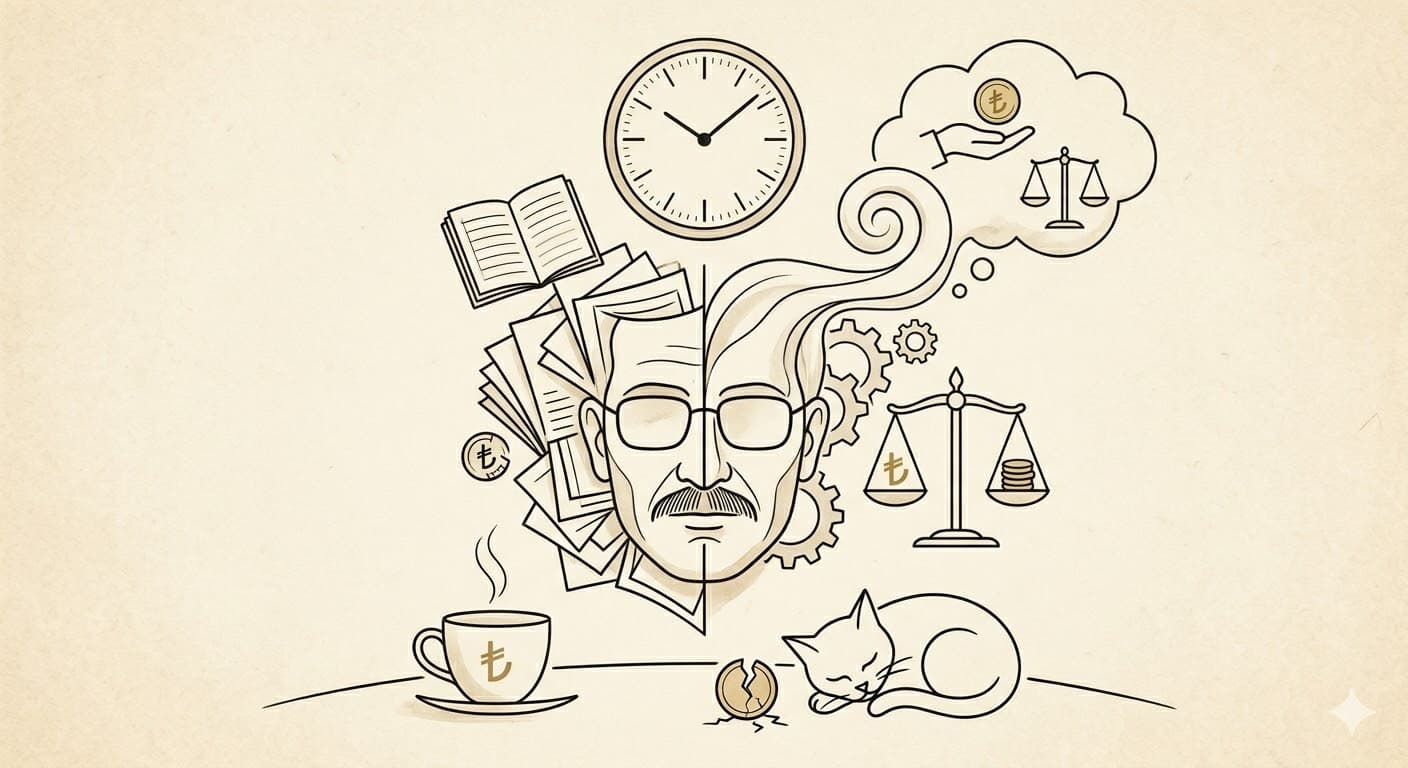
How Many American Minutes Is One Turkish Hour?
How is it that we receive such poor marks in a subject about which we claim to know so much? The real question is not about the dollar—it is about the value of our own time.
How Many American Minutes Is One Turkish Hour?
Same Old.
I am not sufficiently informed about the parameters, formulas, and criteria that determine the value of money. So it is not really a matter I can speak about. Besides, our coffeehouses, tea corners, cafés, Twitter pundits, and Instagram socialites—people of every age from seven to seventy—are already well informed on this subject and even carry out rather “literary” conversations about it. In a country where we encounter an economist at every turn, opening a debate about the value of money would be pointless. Everyone already knows, after all.
Yet I cannot help but ask: how is it that we receive such poor marks in a subject about which we claim to know so much? As an outsider to the matter, when I lend an ear to the masters of the subject, I usually learn that there is always a person or an institution responsible. I do not inquire too curiously, for I fear that the voices—swelling with anger—might turn into an explosion. As a way of changing the subject, or rather calming things down, someone eventually says, “Alright then, understood. And what about you—what’s going on in your life?” At that moment, the thunderous and moving voices of those heroic all-knowing saviors of the nation suddenly transform into the innocent face of a hungry little kitten saying, “Meow!”
“Same old.”
There is nothing beyond that “same old.” Nothing new to be said about oneself, no development worth mentioning; the subject is closed, the conversation ends, and one reaches for the phone to check the latest news. Ten days ago, he was talking about the dollar. Ten months ago, he was saying, “The country is going downhill.” Ten years ago, everything was still someone else’s fault. And yet when the dollar reached ten liras, it was not the same. One should not be surprised that those who have lived the same single day for ten years greet the dollar reaching ten liras with astonishment. They simply need topics that will rescue that one day of theirs from being “the same.”
In every corner of this many-angled tableau, there are large question marks—about humanity and about myself—that are entirely independent of the daily agenda. But two of them loom larger than the rest:
-
If everything is someone else’s responsibility and I play no role in determining the value of money, then what is the value of my own existence?
-
In ten years, the value of money can rise from one to ten. In ten years, how has the value of one hour of my life changed?
While we try to express our existence through a constant chorus of complaints, are we aware that we are actually devaluing it? When we shift the responsibility for a problem that directly concerns us onto someone else, do we see that we are enlarging that problem to our own detriment? Can a person who cannot add value to his own existence claim to add value to anything else?
If we spent the time we devote to complaints, criticisms, and accusations on producing solutions and assuming responsibility, perhaps we would truly become capable of producing value. Complaints about our families, our spouses, our relatives, our friends, our jobs, the administration, and even things we neither know nor understand never seem to end. With these complaints we send responsibility away, always addressed to someone else. So what have we produced and what have we gained? What has changed? What has developed?
Same old.
Can we give meaning to our life story by repeating and epic-izing the mistakes and neglect of our family and relatives toward us? Will we find a remedy by scratching the wounds of the past at every opportunity?
Can we add value to our lives by making the education system the scapegoat for every failure? Can we solve a math problem by cursing mathematics?
Will we shape our lives by taking someone else’s mistake as our measure? Can we write a new history by waging war against our own?
Of course, we must take a stand against what is wrong. But complaints that assume no responsibility and criticisms that build nothing cannot carry us to a better place than where we stand. The quarrel grows, the noise multiplies, the protest rises—just as it did yesterday and the day before. Nothing changes. We cannot go beyond “Same old.” Ten years ago we were producing complaints; now we are producing complaints again. As the capital of our lifetime is being spent, why does our time not gain value?
Related Articles

Comments (0)
No comments yet. Be the first to share your thoughts!